Last Updated on October 7, 2026 by Sam Thompson
Search just changed — and not in a small way. Google’s AI Search Mode is the most fundamental shift in how the search engine operates since it launched. If you create content, run a website, or depend on organic traffic in any way, this is the update you can’t afford to ignore.
This guide breaks down exactly what Google AI Search Mode is, how it differs from everything that came before it, and — most importantly — what you need to do right now to stay visible inside it.
What Is Google AI Search Mode?
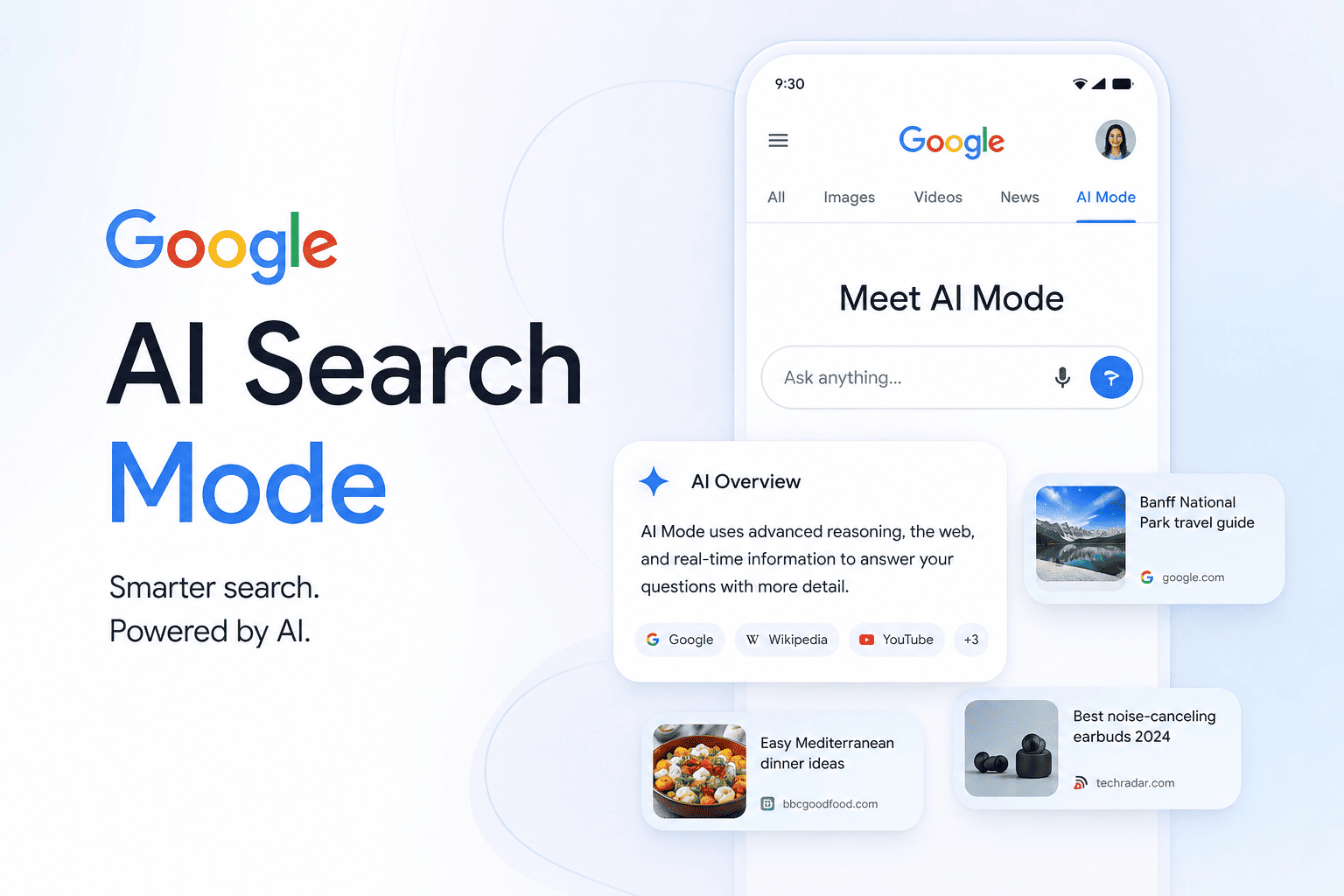
Google AI Search Mode (also referred to as AI Mode) is an opt-in search experience powered by Google’s Gemini AI model. It launched in the United States in May 2025 at Google I/O and represents a complete departure from the traditional ten-blue-links results page.
When a user clicks into AI Mode via the dedicated tab in Google Search, the entire interface transforms. There are no ranked blue links. Instead, Gemini reads, synthesizes, and directly answers the query — and then allows the user to continue the conversation with follow-up questions, just like chatting with an expert.
This is not the same as AI Overviews, which you’ve likely already seen. Understanding the difference matters.
AI Mode vs. AI Overviews: What’s the Difference?
AI Overviews launched in 2023 and appear automatically at the top of standard Google search results. They’re a generated summary layered on top of the existing results page — an addition, not a replacement.
AI Mode is a full replacement. When activated, it swaps out the entire results page for a conversational Gemini interface. The user types a question, receives a synthesized answer with cited sources, and can ask follow-ups in a back-and-forth dialogue. Context from earlier in the conversation carries forward — Gemini knows what you were just discussing.
Think of AI Overviews as Google adding a summary to the top of search. AI Mode is Google replacing search with a conversation.
How Does Google AI Search Mode Actually Work?
Under the hood, AI Mode uses a technique Google internally calls query fan-out. When you submit a complex query, Gemini doesn’t run a single search. It breaks your question into multiple parallel sub-queries, retrieves results from each, synthesizes those results together, and produces a single unified answer.
For example, a query like “What’s the best VPN for someone who works remotely and needs to access US streaming services cheaply?” gets decomposed into sub-questions about VPN performance, streaming compatibility, pricing, and remote work reliability — all run simultaneously, then merged into one coherent response.
The model powering this is Gemini 2.0, with Gemini 2.5 rolling out progressively. It’s multimodal, meaning users can include images in their queries — not just text.
Why This Is Genuinely the Biggest Search Shift in Decades
The reason this matters so much isn’t just the new interface — it’s what changed underneath:
- Google’s role shifted from retriever to synthesizer. For 25 years, Google found content and pointed users toward it. AI Mode reads the content and delivers the answer itself. Your page is now an input, not the destination.
- Zero-click outcomes are increasing. When Gemini answers a question fully, users don’t need to click anywhere. Publishers who monetize via pageviews are already seeing the impact from AI Overviews — AI Mode intensifies it.
- Search queries are getting longer and more complex. Google is actively encouraging conversational, multi-part queries because AI Mode handles them far better than traditional search ever could.
- Search is becoming agentic. Google has announced plans to extend AI Mode into autonomous task completion — booking, purchasing, filling forms. Search is evolving into an AI agent, not just a lookup tool.
How Does AI Mode Decide What Content to Cite?
This is the question every content creator and SEO professional needs to understand. The short answer: AI Mode doesn’t just rank content — it evaluates whether it can extract and reliably attribute information from it.
Structure and Parsability Come First
Gemini needs to be able to understand your content. Pages that are technically heavy (JavaScript-rendered, hard to crawl), structurally unclear, or light on actual substance are at a disadvantage. Clear headings, short paragraphs, and well-organised sections make your content machine-readable — and that matters more now than ever.
E-E-A-T Signals Are Weighted More Heavily
Google’s E-E-A-T framework (Experience, Expertise, Authoritativeness, Trustworthiness) has always influenced rankings. In AI Mode, the stakes are higher. Poor E-E-A-T in traditional search hurts your ranking. In AI Mode, it can mean you’re not cited at all. Named authors, verifiable credentials, citations to primary sources, and first-hand experience all carry more weight.
Topical Depth Beats Individual Page Optimisation
AI Mode favours sites that cover a topic comprehensively. A domain that has multiple well-structured articles on a subject — beginner guides, comparisons, deep dives, FAQs — signals topical authority more strongly than a single well-optimised page surrounded by unrelated content.
Schema Markup Provides Semantic Signals
FAQ schema, HowTo schema, Article schema, and Review schema all help Gemini understand what type of content lives on a page and what questions it addresses. This has always been good practice — in AI Mode, it’s more directly useful because it gives the model explicit signals about your content’s intent and structure.
How to Optimise Your Content for Google AI Search Mode
Optimising for AI Mode isn’t a complete departure from good SEO — but the emphasis shifts in ways that matter significantly.
Lead With the Answer
Traditional content often buried the answer after an introduction. AI Mode rewards the opposite: lead with a direct answer to the question, then explain and expand. This inverted pyramid structure makes it far easier for Gemini to extract a citeable answer from your content.
Use Descriptive, Question-Style Headers
H2 and H3 headers that mirror how real people ask questions are more likely to match AI Mode queries. “How does AI Search Mode work?” is a better header than “Overview.” Specific, descriptive headers also help Gemini attribute the right section of your content to the right query.
Write for Multi-Part Queries
AI Mode is designed for complex, conversational questions. Content that addresses multiple angles of a topic — and anticipates logical follow-up questions — is more likely to be cited across multiple turns of a conversation. Rather than writing one narrow article targeting a single keyword, build content that covers a topic cluster thoroughly.
Keep Paragraphs Short and Scannable
Two to four sentences per paragraph is ideal. Long walls of text are harder for Gemini to extract clean information from. Short, direct paragraphs with clear transitions perform better in AI-synthesised environments.
Include an FAQ Section on Every Article
FAQ sections are highly extractable. A well-crafted FAQ — with specific questions and concise, direct answers — gives AI Mode a structured source to cite for question-based queries. Use FAQ schema markup to reinforce this signal.
Demonstrate Real-World Expertise
Generic, surface-level content is increasingly invisible in AI Mode. Gemini has thousands of sources to choose from — it gravitates toward content that shows genuine expertise: first-person testing, named authors with verifiable backgrounds, references to original research, and regular content updates that signal active maintenance.
What About Zero-Click Searches?
Zero-click outcomes — where a user gets their answer directly in the search interface without visiting any website — are a real concern. AI Mode accelerates this trend. For publishers, the practical response involves a few strategies:
- Optimise to be cited, not just ranked. Even when a user doesn’t click through, being cited in AI Mode builds brand recognition and authority over time.
- Create content with value beyond information. Tools, templates, calculators, comparison engines, and interactive resources give users a reason to click through even after getting a summary answer.
- Target purchase-intent and transactional queries. AI Mode provides information, but buying still happens on your website. Affiliate-focused content targeting commercial intent remains valuable.
- Build brand recognition. Users who know and trust your brand will click through to it even when a synthesised answer is available. Long-term brand investment in content pays off.
What to Stop Doing for SEO
As important as the optimisation advice above is, some legacy SEO tactics are now actively counterproductive:
- Stop publishing thin content at scale. Hundreds of short keyword-targeting pages was once a valid strategy. AI Mode synthesises from comprehensive sources — one thorough article often outperforms a cluster of thin ones.
- Stop burying the answer. If the actual answer to the user’s question is in paragraph twelve after five paragraphs of preamble, AI Mode may not cite it even if the information is accurate.
- Stop ignoring structured data. Schema markup is no longer optional for content that wants AI Mode visibility.
- Stop separating content quality from SEO. In AI Mode, they are the same thing. Content that is genuinely useful and well-organised is also the content most likely to surface.
Frequently Asked Questions About Google AI Search Mode
What is Google AI Search Mode?
Google AI Search Mode is an opt-in conversational search experience powered by Gemini. It replaces the traditional results page with a direct-answer interface that supports follow-up questions and maintains context throughout a session. It launched in the US in May 2025.
Is AI Mode available outside the United States?
As of mid-2026, AI Mode is primarily available in the United States. Google has indicated broader international rollout is planned, but specific timelines for additional regions have not been confirmed publicly.
Will Google AI Search Mode hurt my website traffic?
It may reduce traffic for purely informational queries, since users can get answers without clicking through. However, content cited in AI Mode still gains brand exposure, and commercial intent queries still drive click-throughs. Publishers with strong topical authority and content that goes beyond basic information are better positioned to maintain traffic.
How do I get my content cited in AI Mode?
Focus on clear structure, answer-first writing, genuine expertise signals (named authors, first-hand experience, primary source citations), comprehensive topic coverage, FAQ sections, and schema markup. Shallow content targeting individual keywords is less likely to be cited than in-depth resources that address a topic from multiple angles.
Does AI Mode use the same ranking signals as traditional Google Search?
Partially. Core signals like domain authority and on-page SEO still matter, but AI Mode also weights content parsability, topical depth, and E-E-A-T more heavily. Strong traditional SEO is a foundation, not a guarantee of AI Mode visibility.