Last Updated on July 21, 2026 by Sam Thompson
String comparison is one of the most common operations in any programming language, and Go (Golang) provides a variety of tools to handle it accurately and efficiently. Whether you are validating user input, sorting lists, comparing configuration values, or handling Unicode text, it’s important to understand how string comparison works in Go and which approach suits your use case.
This guide explains how to compare strings in Go using standard library functions and best practices, with examples and explanations tailored to real-world development scenarios.
Basic String Equality Using ==
The most direct way to compare two strings in Go is with the equality operator ==. This checks whether two strings are byte-for-byte identical.

This comparison returns true if the two strings are exactly the same, including length, casing, and byte content. Go strings are immutable and stored as read-only byte sequences, so this operation is fast and efficient.
However, this method is case-sensitive. A string like “Golang” compared to “golang” will return false. This approach is best when strict matching is required, such as when validating internal identifiers or checking fixed string values.
Case-Insensitive Comparison with strings.EqualFold
When you need to compare strings without considering case, use the strings.EqualFold function from the standard library.
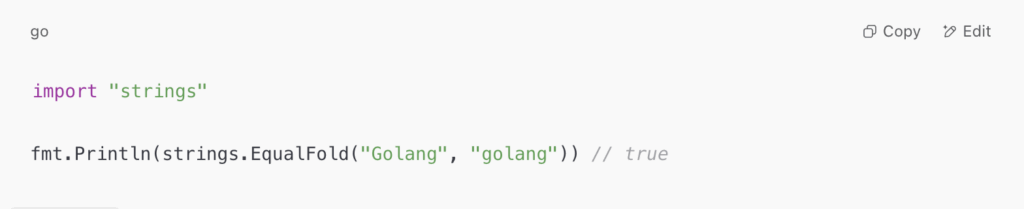
EqualFold performs a Unicode-aware, case-insensitive comparison. It is safer and more reliable than manually converting strings to lowercase, especially when dealing with international characters. This method is useful when validating user input such as email addresses, commands, or names, where case should not affect equality.
Lexical Comparison Using strings.Compare
If the goal is to determine which string comes first in dictionary or lexicographical order, Go provides the strings.Compare function.
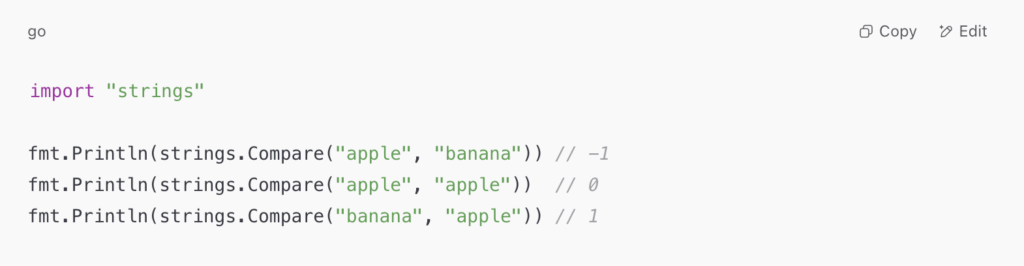
This function returns:
- 0 if the strings are equal
- A negative value if the first string is less than the second
- A positive value if the first string is greater than the second
It is commonly used in custom sorting functions or when building alphabetical indexes.
Finding Substrings with strings.Contains
To check whether one string contains another, use strings.Contains. This function returns true if the substring is found anywhere within the target string.

This is ideal for search features, content filtering, or parsing structured data. You can also use related functions like strings.HasPrefix and strings.HasSuffix to check if a string starts or ends with a particular substring.
Trimming Strings Before Comparison
When comparing strings from external sources, such as user input or data files, leading and trailing whitespace can cause mismatches. Go provides strings.TrimSpace to remove unnecessary spaces before performing comparisons.
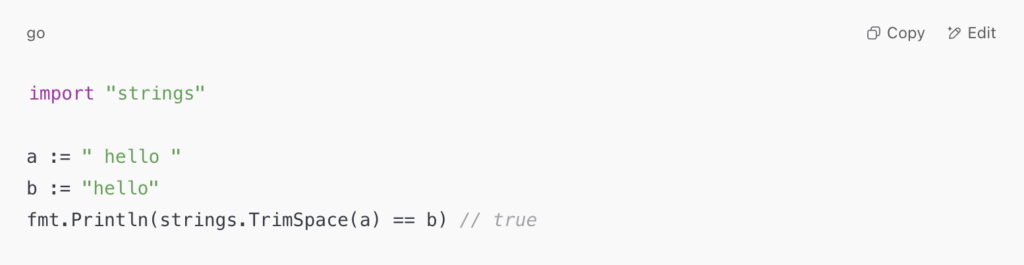
You can also use strings.Trim to remove specific characters or patterns. Trimming is especially important when reading lines from files or processing form submissions where formatting can be inconsistent.
Comparing Byte Slices with bytes.Equal
Go strings are immutable and often converted to byte slices when working with binary data. However, byte slices cannot be compared with ==. Instead, use bytes.Equal from the bytes package.
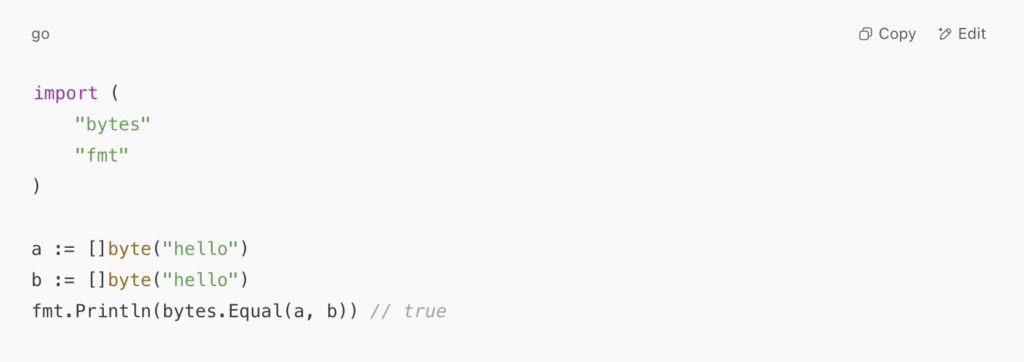
This function performs a deep comparison of two byte slices. It is useful when working with file contents, binary protocols, or cryptographic operations.
Handling Unicode with Normalization
Unicode strings may appear identical but differ in their internal representation. For example, accented characters like “é” can be encoded in multiple ways. To compare them reliably, normalization is required.
Go provides support for Unicode normalization through the external package golang.org/x/text/unicode/norm.
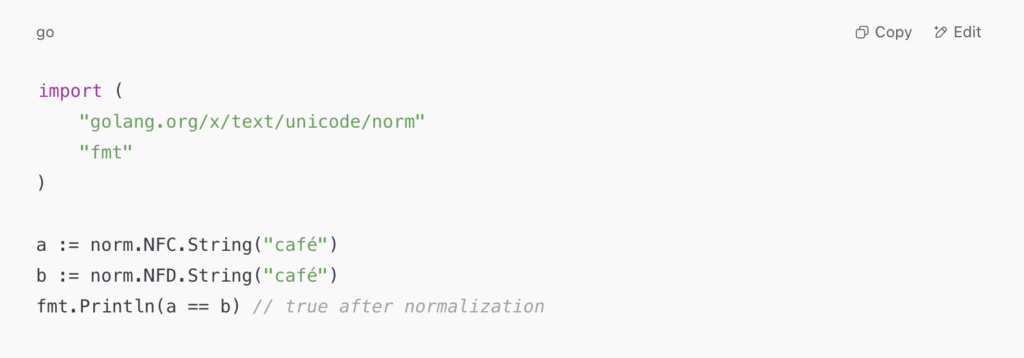
Normalization converts strings to a consistent form before comparison. This is essential when working with multilingual data, file systems, or user-generated content where encoding inconsistencies can cause subtle bugs.
Comparing Large Strings Efficiently
In performance-sensitive applications, comparing large strings repeatedly can become expensive. One strategy is to compare hash values instead of raw strings. Go’s crypto/sha256 package can help here.
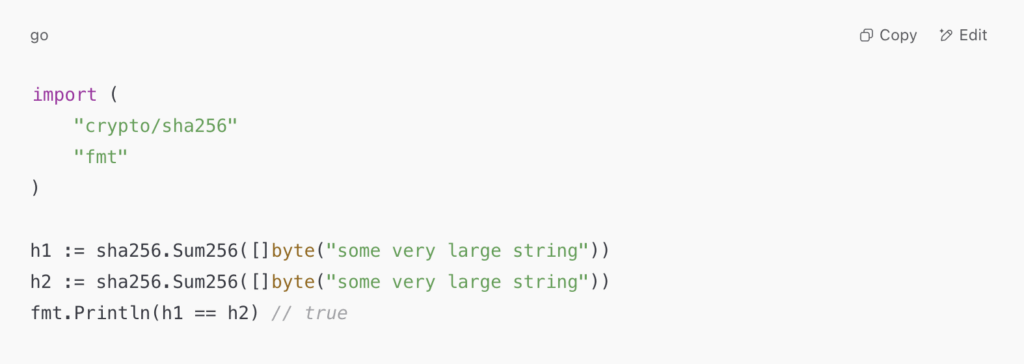
This approach is useful for deduplication, file synchronization, or verifying data integrity, where exact matches are needed without scanning the entire content every time.
Custom Comparison Logic
In many cases, string comparison needs to follow specific rules such as ignoring whitespace, case, or punctuation. You can define a reusable function that combines these checks.
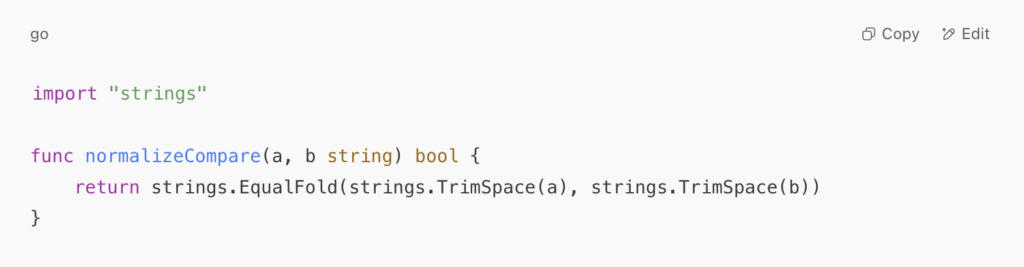
This kind of abstraction improves code readability and ensures consistency across your application. It is especially helpful in input validation, API parsing, or automated testing scenarios.
Additional Golang String Comparison Methods and Performance Considerations
Go offers various string comparison methods beyond the basic ones, each with distinct performance characteristics and use cases. For instance, using relational operators such as <, >, <=, and >= allows you to perform lexicographical comparison of strings lexicographically, which compares two strings lexicographically based on dictionary order. This is particularly useful when sorting or ordering strings.
It is important to understand that uppercase letters come before lowercase letters in lexicographical order, which can affect sorting results. The inequality operators provide three way comparisons, returning boolean values based on whether one string is lexicographically greater or smaller than another.
While the strings.Compare function returns an integer indicating the lexicographical relationship between two strings, it is generally discouraged in favor of direct comparison operators due to performance justification concerns and runtime cmpstring function optimizations in Go. The Go team recommends using comparison operators for more efficient string comparisons.
When comparing strings, consider the memory footprint as well. For example, the len() function returns the length of a string in bytes, which can be used to quickly determine if two strings could possibly match before performing a more expensive comparison. This is especially useful when dealing with empty string values or strings of vastly different sizes, as comparing strings with more memory can be more costly.
In Go, the strings package provides a comprehensive set of functions to facilitate string comparison and manipulation. Using the package main import statement, you can access these functions in your programs. Within your func main, you can declare variables of type string s and perform comparisons using various methods.
For case insensitive string comparison, strings.EqualFold is the most reliable method, as it correctly handles case differences and edge cases across Unicode characters. It avoids pitfalls that arise from manual lowercase conversions, which might not correctly handle all edge cases.
For checking if two strings match partially or fully, functions like strings.Contains, strings.HasPrefix, and strings.HasSuffix are invaluable. They allow you to perform case sensitive search operations efficiently.
In summary, understanding the different methods to compare strings in Golang, including equality operators, relational operators, the compare function, and specialized package functions, allows you to write efficient and readable code. Knowing when to use each method based on your specific use case and performance needs is key to mastering strings in Golang programming.
Understanding performance characteristics in languages like Go is not just important for writing efficient code, but also for long-term career growth. Performance-focused languages tend to offer strong career opportunities, and Go consistently ranks well in terms of demand and compensation, comparable to other highest-paid programming languages.
Summary of Comparison Methods
Here’s a quick overview of the most commonly used string comparison tools in Go:
| Method | Case Sensitive | Use Case |
|---|---|---|
| == | Yes | Exact matches |
| strings.EqualFold | No | Case-insensitive input or matching |
| strings.Compare | Yes | Lexical sorting or ordering (less recommended) |
| strings.Contains | Yes | Substring checks or keyword search |
| bytes.Equal | Yes | Comparing byte slices or binary content |
| unicode/norm | Depends | Unicode-safe equality |
| Trim and normalize + == | Optional | Cleaned-up input comparison |
Recommended Resources
For further reading and official documentation, refer to the following trusted sources:
- Go strings package (pkg.go.dev)
- Go bytes package (pkg.go.dev)
- Effective Go: Strings
- The Go Blog: Strings
- Unicode normalization in Go (golang.org/x/text/unicode/norm)
Conclusion
String comparison in Go is both powerful and straightforward when you understand the tools available in the standard library. Whether you’re performing exact matches, checking for partial strings, or normalizing Unicode input, Go provides reliable, performant ways to handle all of these tasks. Choosing the right comparison method depends on your use case, and with the right techniques, you can write string comparison code that is both accurate and maintainable.